



LatchBio received $28M to expand its platform.
Biologists and other scientists are now presented with a vast amount of data and a dizzying array of instruments to apply it with, many of which need specialized knowledge. The search for an experienced professional is difficult, and contracting out the work might take months. With LatchBio, though, you can run your data through Alpha Fold and other top-tier tools in just a few minutes. The firm just received $28 million to expand its platform, becoming increasingly important. Fundamentally, the problem is that not every scientist is a data scientist. "As good as biologists are in biology, pipetting, and lab work, they're terrible at programming," said Alfredo Andere, co-founder and CEO of LatchBio. However, the biotech revolution is propelled by the massive rise of data generated by each experiment.
LatchBio: An Integrated Platform for Bioinformatics
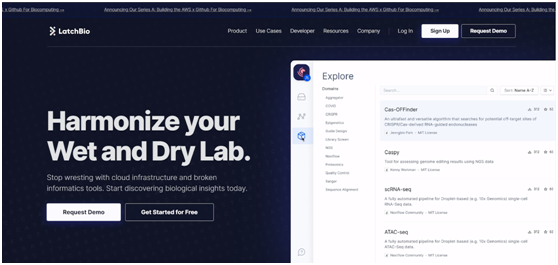
Andere and his co-founders, CTO Kenny Workman and COO Kyle Griffin, came from the Big Tech business but got disillusioned with it. They had these incredible data pipelines at Google, but they were only used to serve to advertise. Then they saw that these biotech businesses were healing diseases but that their data pipelines were the worst. So why not utilize the same capability and simplicity of use as a Google-tier product but tailored to scientists who can't write a single line of code? That is the goal of the company's Latch platform, which prioritizes usability and adaptability over anything else. "You have to make it easy for the scientists. You need technology that lets them upload, then fill in like three parameters and a press run," Andere added. "It's a big model, just like AlphaFold. We observed this at Berkeley, where they tried for weeks to install it on a GPU cluster but couldn't. It's simply too complicated. We offered them our platform, which allows them to enter an amino acid sequence and execute it. We had [genetic sequencing pioneer] George Church in the other day, and we had him running AlphaFold on the platform in less than 30 seconds," Andere remarked. It may have been possible to process it yourself with minimal tools a few years ago. Still, the amount has grown a thousandfold or more, and every discovery (such as cheaper genome sequencing or new methods to use that data) adds to the problem. "If you conduct a CRISPR experiment, you sequence it in an Illumina machine after you make the modification in the wet lab." It returns a file containing the RNA string and the changes you made, but it's not one of them; it's 10,000," Andere explained. "If you're just a biologist, you need to learn how to use CRISPResso, how to use the command line, how to install dependencies, and how to give it the appropriate data," Andere added. Ask one of the scientists if this all seems a little childish. The first to claim they don't want to work with code will almost certainly be biologists. Good scientists are intelligent individuals who choose to concentrate on what they do best rather than learning a new subject in order to make sense of the avalanche of data. There are other scientists who should be doing that! When you consider how diverse the disciplines of biology and biotech are, you can see the problem. Proteomics, epigenetics, and the dozens of subdomains within each have their own set of software tools and methods. They were able to get out of this position by purchasing a chicken, as he put it. They created popular procedures and distributed them to biologists, then utilized the input to develop their SDK so that they could provide something simple to computational types. Alternatives, according to Andere, include cloning GitHub repositories and other notebooks, as well as recovering code from papers and personal websites. Computational biologists, like their pipette-wielding cousins, aren't gluttons for suffering, so anything that makes their lives simpler is appreciated. Using the SDK to add their procedure to Latch means that the scientists who are filling up their inbox can do it themselves. The business intends to have earned $1 million in ARR by the end of the year, and contracts are stacking up. Andere, on the other hand, stressed that the platform would always be free for academics (despite the fact that their licence status might be a hassle), who would rather wait a month than spend $5,000. The $28 million is a significant sum. Hummingbird Ventures, Caffeinated Capital, Haystack, and Fifty Years were among the investors in a round-headed by Coatue and Lux Capital, with participation from Hummingbird Ventures, Caffeinated Capital, Haystack, and Fifty Years. Andere stated that they intend to employ the greatest software engineering team in the biotech industry in addition to building out the product. "I think young people are bored of working at optimization and quantitative firms — there's no company in biotech that symbolizes being among the world's greatest software engineers while also working on world-changing challenges," he concluded. LatchBio, naturally, aspires to be just that.