



After launching its own women's health clinic as an app last year to examine digital healthcare from the inside, French startup Nabla is taking the next step in its planned pivot to b2b, announcing that it's opened its machine learning tech stack to other digital health businesses and healthcare providers so they can offer "personalized medicine."
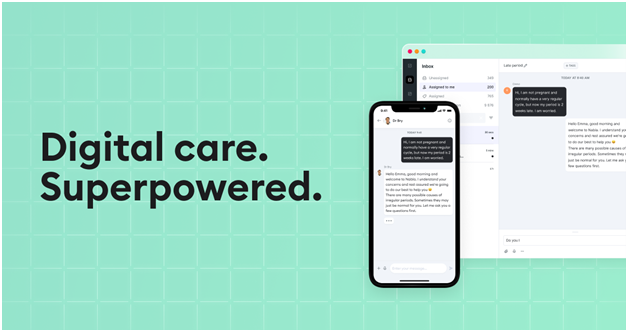
Whether the client is offering real-time telehealth consultations or providing a service to patients via asynchronous and text-based messaging. Nabla's AI-powered patient communications and engagement/retention platform is designed to support clinicians in providing a more continuous, data-driven service.
Nabla’s communication modules
Nabla's messaging, and teleconsultation communication modules sit on top of the customer healthcare service, ingesting and structuring patient data, supporting clinicians with real-time prompts and visualizations, and offering ongoing patient outreach features to extend service provision.
Based on the AI's ability to aggregate patient activity and surface contextually relevant data, the startup claims that its approach can improve medical outcomes by enabling healthcare professionals to ask relevant questions during a consultation — and afterwards, with features like automated transcription and suggesting updates a clinician could make to a patient's medical file.
It compares the platform's capabilities to having a very attentive family doctor who knows their patient's complete medical history and situation — and has an impeccable memory. However, the technology can go beyond even the best doctor can provide. It allows healthcare providers to supplement in-person consultations with ongoing, asynchronous outreach to provide a layer of continuous care.
Nabla's premise is that combining digitally delivered, human care with data-driven (AI-powered) support and asynchronous follow-ups can provide a win-win situation for both patients and digital health businesses. Patients get more ongoing care than they could expect from traditional healthcare service delivery, and digital health businesses get to drive customer engagement and retention.
"Our long-term goal is to use this data, not just for the benefit of one patient but also learn and aggregate all this data and, for instance, try to predict what will happen next with the patient or do faster diagnostics," he tells TechCrunch. "Of course, the data we have is super valuable for research because we have very, very detailed information about the patient and not just the typical hospital records. We know it's essential for health, what they eat, how they live, their social environment, and their family environment, but this information is nowhere to be found in existing medical records. But we have part of it. And so this is incredibly valuable for future academic research — and when we ask our users would agree to share this data for medical research… most say yes, of course, if they understand the scope of what we share." Lebrun got his start in tech by working on chatbots, and he clearly understands the technology's limitations. He stayed on at Facebook after selling a previous AI startup (Wit.ai) to work on the company's hybrid general-purpose AI concierge service, which Facebook ultimately decided did not scale for its user base.
Future of Digital Healthcare
According to Nabla, customer retention has become a pressing problem for digital healthcare providers. After the surge of interest in space during the pandemic, many businesses are likely to hit a snag as patient attention disperses. The wider global downturn makes scaling by raising funds more difficult.
Currently, Nabla isn't in the business of automating healthcare; instead, its platform provides real-time clinician support and clinician-approved patient outreach, which means that a qualified human doctor is always in the loop and in charge of patient care decision-making. As a result, its product is not a medical device in and of itself, though LeBrun sees himself moving in that direction in the future.
Nabla's founders learned about the needs of the industry they wanted to supply and support with machine learning software by starting and running a women's health clinic, which they launched as an app in April 2021. The app, which Nabla says will keep running, for the time being, has 25,000 users so far.
As a result of this approach, Nabla's technology is in the relatively unique position — at least in comparison to general health products in the past — of being informed primarily by women's experience during development. The clinic provided Nabla with direct access to patients and doctors and the data and expertise it needed to develop the machine learning health stack product it is now attempting to monetize. Although it emphasizes that patient data confidentiality requirements have meant always working with strict data access limits, such as its engineers not being able to directly access users' medical information — it also emphasizes that it has always worked with strict data access limits.
Nabla's competitive advantage, according to Groll is its focus on not just extracting what patients tell their doctors but also structuring that information so that it can be used to improve healthcare provision for them by surfacing suggestions for personalized follow-ups.
"When we are talking to potential clients, what they like at the end of the day is we are extracting the data from all the communication — especially messaging and teleconsultation — and we are not only extracting it… we are also structuring it and normalizing it so it can make a strong asset for them," she says, adding: "So I believe our differentiation is… we are enabling them to have a communication module but also to have a way to leverage the data they have inside those communications."
On the research side, Lebrun believes the approach will likely entail collaborations between Nabla's healthcare provider partners and public research institutions that will conduct studies in specific areas of interest using aggregated, anonymized data from the service providers, assuming Nabla scales usage.